AI for Decisions That Shape Communities
The SCOPE Lab builds foundational AI methods for decision-making in societal-scale cyber-physical systems — piloting and evaluating real-world solutions in mobility, energy, and emergency response.
The SCOPE Lab builds foundational AI methods for decision-making in societal-scale cyber-physical systems — piloting and evaluating real-world solutions in mobility, energy, and emergency response.
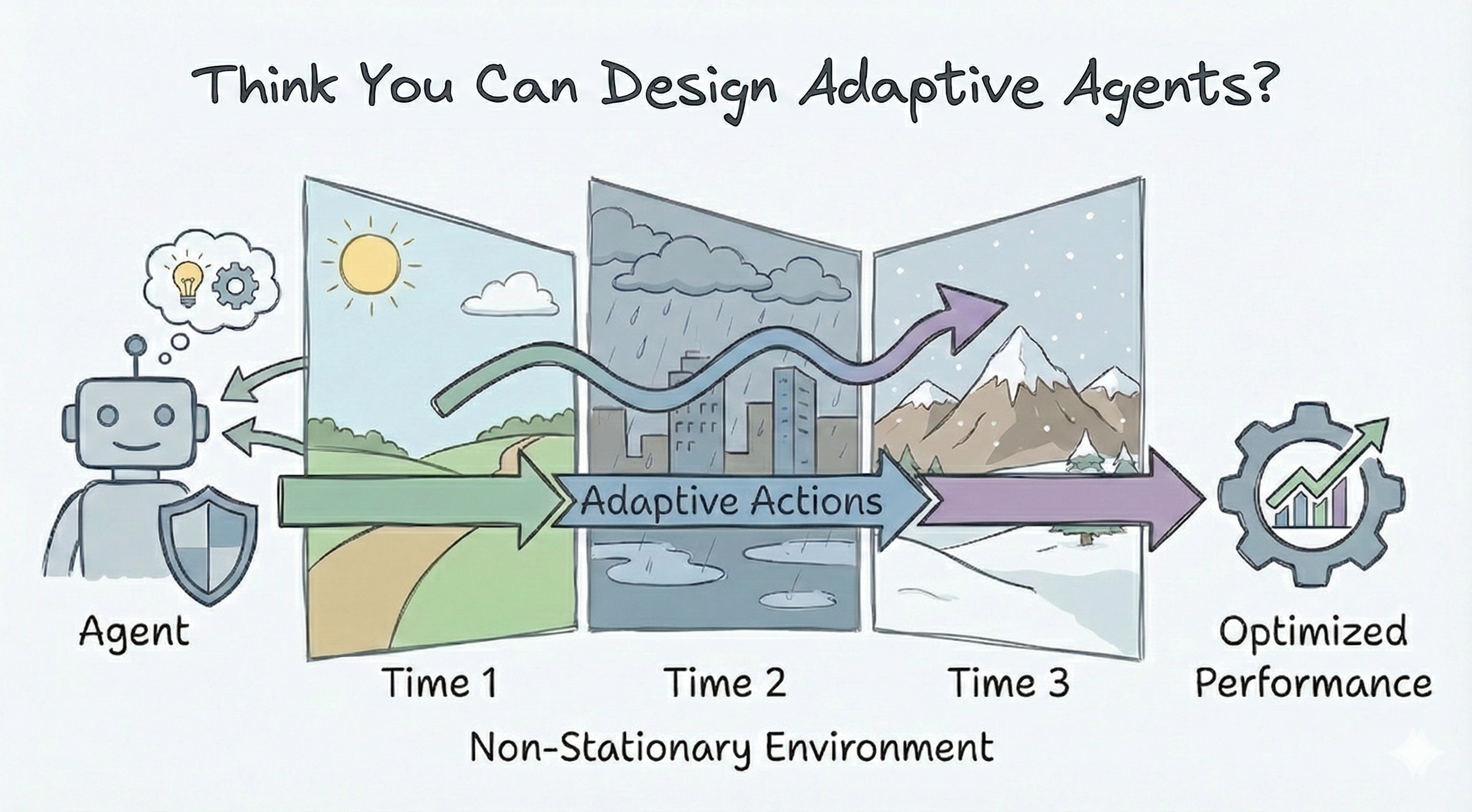
Image generated by Gemini Nano Banana Pro
Real-world environments are non-stationary — transit demand shifts, energy prices fluctuate, and emergency patterns evolve. NS-Gym is the first open-source simulation framework for non-stationary MDPs, built on OpenAI Gymnasium. It separates environmental dynamics from agent decision-making so you can benchmark RL, planning, meta-learning, and continuous learning algorithms under realistic change. Learn how at our CPS-IoT Week tutorial, then put your agents to the test in the AAMAS 2026 competition.
Dr. Baiting Luo successfully defended his dissertation, Adaptive and Scalable AI-Driven Decision-Making for Cyber-Physical Systems, marking an important milestone for the lab.
June 2026SCOPE Lab received the Best Demo Award at RTCSA 2026. Certificate →
SCOPE Lab received the Outstanding Paper Award at RTCSA 2026. Certificate →
Michael Yuhas received the Outstanding Reviewer Award at RTCSA 2026. Certificate →
Agrima’s paper won the Best Paper Award at SMARTCOMP 2026 for her work on Dynamic Pickup-and-Delivery Routing with Early-Arrival Waiting Limits and Station Relocation. Details →
SCOPE Lab has seven papers accepted at ICCPS 2026 in Saint-Malo, France.
NS-Gym tutorial at CPS-IoT Week 2026 (May 11, Saint-Malo, France) — Decision-Making under Non-Stationarity. Organized by Ayan Mukhopadhyay and Nathaniel Keplinger.
We build AI methods for decision-making in complex, uncertain environments — and test them in real communities. The problems we care about drive the algorithms we develop.
How should a transit agency dispatch vehicles when demand is uncertain and conditions change by the minute? We combine learned policies with online tree search so that planners can adapt in real time without starting from scratch. This work has been piloted with transit agencies in Nashville and Chattanooga.
Learn morePlanners are only as good as their picture of the world, and that picture is always incomplete. GPS has noise, sensors fail, and last month’s demand model may not reflect today’s reality. We build methods that maintain accurate beliefs from noisy data and detect when the environment has shifted.
Learn moreA dispatcher who can’t ask “why did you choose that route?” won’t trust the system. We make planning algorithms transparent and interactive — operators can question decisions, explore alternatives, and inject their own expertise into the search process in real time.
Learn moreAn optimal algorithm is useless if the system hosting it crashes. Starting from safety-critical avionics and spacecraft, we’ve built component-based middleware that handles faults, tolerates adversaries, and runs reliably at the edge — now powering smart grid control as a Linux Foundation project.
Learn morePlanning requires knowing what’s happening now and what’s likely to happen next. We develop machine learning methods that detect incidents across city-wide sensor networks, forecast transit demand and energy loads, and flag anomalies in power grids — the predictive foundation that our planners depend on.
Learn moreReal problems with real partners — transit agencies, fire departments, grid operators, and state DOTs shape what we build and how we measure success.
Over a decade of partnership with transit agencies across Tennessee, we have built AI systems that design microtransit zones, optimize vehicle routing, predict ridership, and manage disruptions for buses, paratransit, and school transportation — from early analytics work in Nashville to a statewide multimodal integration effort.
Our energy research starts from the need to keep power grids reliable and secure, and extends to turning electric vehicle fleets into mobile energy assets. The work spans fault diagnosis, cyber-defense, decentralized energy markets, wildfire resilience, and a deep partnership with Nissan on vehicle-to-building optimization.
Nearly a decade of research connecting incident prediction, responder dispatch, real-time detection, and operational simulation — from early spatial models through deployed tools serving fire departments, state DOTs, and city agencies across Tennessee.
Researchers advancing the science and practice of AI for societal-scale systems.

Director, Associate Professor
Cyber-physical systems, AI decision procedures, smart transportation, resilience

Assistant Professor, St. Mary's University, San Antonio
Out-of-distribution detection, deep learning, embedded systems, smart grid
Former Postdoctoral Researcher at Vanderbilt University
Ph.D. 2026 · Scalable neuro-symbolic decision procedures for non-stationary environments
Ph.D. Student (former) · Dynamic decision procedures for public transit
Ph.D. 2023 · Data-driven algorithms for smart transportation
Now: CEO at Mobius AI
Ph.D. 2022 · Real-time sequential decision making for large-scale CPS
Ph.D. 2022 · Dynamic safety assurance of autonomous CPS
Ph.D. 2020 · Distributed ledgers for multi-stakeholder CPS
Ph.D. 2018 · Algorithms for context-sensitive prediction and anomaly detection
Ph.D. 2017 · Algorithms for managing extensibility in CPS
@inproceedings{gunter2026control,
  title = {Control Barrier Function Based Speed Control for Fixed-Line Transit Headway Management},
  author = {Gunter, George and Talusan, Jose Paolo and Freudberg, Dan and Dubey, Abhishek and Laszka, Aron},
  year = {2026},
  month = sep,
  booktitle = {Proceedings of the 2026 IEEE International Conference on Intelligent Transportation Systems (ITSC)},
  address = {Naples, Italy}
}
We present a control barrier function (CBF) approach for headway management in fixed-line transit systems (FTLSs) through vehicular speed control. We frame headway management as a formal property in terms of vehicle time-differences. Using a dynamical model of vehicle speed control, we develop a combined CBF quadratic-programming (QP) supervisory approach. The CBF-QP supervises control speed inputs for forward-invariance of minimum and maximum time-differences between vehicles. While the need for vehicles to stop creates modeling error that can lead to property violations, the CBFs can recover back to satisfying the time-gap properties after violations. We present numerical experiments that compare the CBF-QP approach to other controllers. We find that the CBF-QP approach is able to supervise a poorly performing controller to achieve significantly improved headway regularity. We additionally compare the CBF-QP with an existing linear-quadratic control approach and find that the CBF-QP performs similarly or better.
@inproceedings{hu2026columngenerationmicrotransitzoning,
  title = {Column Generation for the Micro-Transit Zoning Problem},
  author = {Hu, Hins and Sen, Rishav and Talusan, Jose Paolo and Dubey, Abhishek and Laszka, Aron and Samaranayake, Samitha},
  booktitle = {Proceedings of the Thirty-Fifth International Joint Conference on Artificial Intelligence, {IJCAI-26}},
  publisher = {International Joint Conferences on Artificial Intelligence Organization},
  editor = {Calvanese, Diego},
  pages = {7219--7228},
  year = {2026},
  month = aug,
  note = {AI and Social Good},
  doi = {10.24963/ijcai.2026/803},
  url = {https://doi.org/10.24963/ijcai.2026/803},
  eprint = {2603.07821},
  archiveprefix = {arXiv},
  primaryclass = {math.OC},
  keywords = {micro-transit, zoning, column generation, combinatorial optimization, urban mobility, demand-responsive transit, public transportation},
  what = {This paper generalizes the Micro-Transit Zoning Problem to incorporate a global budget constraint on operational costs rather than a fixed limit on the number of zones. The work reformulates the problem into a Column Generation framework where candidate zones are generated iteratively through a pricing subproblem, and develops a scalable pricing heuristic that replaces exact integer programming with a greedy node-addition strategy. The approach is validated on real-world mobility data from five major U.S. cities including Chattanooga, where CARTA provided origin-destination trip data.},
  why = {Micro-transit services require carefully designed geo-fenced zones to operate effectively, but existing computational methods impose unrealistic constraints like fixed zone counts and suffer from scalability issues in larger cities. The innovation is applying Column Generation — a decomposition technique from operations research — to the zoning problem, which naturally handles the exponentially large space of candidate zones by generating only promising candidates guided by dual variables. This also enables a more realistic global budget formulation that reflects how transit agencies actually plan service areas.},
  results = {Experiments across Miami, Boston, Atlanta, Chattanooga, and Nashville demonstrate that the CG framework produces higher-quality solutions than the state-of-the-art two-phase enumeration approach while scaling more efficiently to larger cities. The pricing heuristic achieves near-optimal solution quality with dramatically reduced computation time, making the approach practical for real-world deployment. Additional analysis provides parameter tuning guidance for transit agencies adopting the method.},
  project_tags = {transit, planning}
}
Along with the rapid development of new urban mobility options like ride-sharing over the past decade, on-demand micro-transit services stand out as a middle ground, bridging the gap between fixed-line mass transit and single-request ride-hailing, balancing ridership maximization and travel time minimization. However, effective operation of micro-transit services requires planning geo-fenced zones in advance, which involves solving a challenging combinatorial optimization problem. Existing approaches enumerate candidate zones first and select a fixed number of optimal zones in the second step. In this paper, we generalize the Micro-Transit Zoning Problem (MZP) to allow a global budget rather than imposing a size limit for candidate zones. We also design a Column Generation (CG) framework to solve the problem and several pricing heuristics to accelerate computation. Extensive numerical experiments across major U.S. cities demonstrate that our approach produces higher-quality solutions more efficiently and scales better in the generalized setting.
@inproceedings{AkhannaSmartcomp2026,
  title = {Dynamic Pickup-and-Delivery Routing with Early-Arrival Waiting Limits and Station Relocation},
  author = {Khanna, Agrima and Pavia, Sophie and Liu, Fangqi and Mukhopadhyay, Ayan and Dubey, Abhishek},
  year = {2026},
  month = jun,
  booktitle = {2026 IEEE International Conference on Smart Computing (SMARTCOMP)},
  note = {Won the Best Paper Award},
  contribution = {lead},
  project_tags = {CPS, optimization, transit},
  certificate = {/files/awards/SmartComp2026_Certificate.pdf}
}
@inproceedings{gupta2026damctsdemo,
  author = {Gupta, Samir and Yuhas, Michael and Lei, Qiaosi and Dubey, Abhishek},
  title = {Demo: Deadline-Aware Real-Time Planning on F1TENTH},
  booktitle = {Proceedings of the 32nd IEEE International Conference on Embedded and Real-Time Computing Systems and Applications (RTCSA)},
  year = {2026},
  address = {Qingdao, China},
  publisher = {IEEE},
  certificate = {/files/awards/RTCSA2026-best-demo.pdf}
}
@inproceedings{gupta2026damcts,
  author = {Gupta, Samir and Yuhas, Michael and Dubey, Abhishek},
  title = {{DA-MCTS}: Deadline-Aware Action Exploration for Safe Real-Time Planning},
  booktitle = {Proceedings of the 32nd IEEE International Conference on Embedded and Real-Time Computing Systems and Applications (RTCSA)},
  year = {2026},
  address = {Qingdao, China},
  publisher = {IEEE},
  url = {https://github.com/scope-lab-vu/DA_MCTS_RTCSA_2026}
}
Real-time motion planning for autonomous racing must operate under strict computational deadlines while maintaining safe and reliable behavior. However, the quality and safety of planning algorithms depend heavily on the computational budget available on the deployment hardware. Policies tuned on powerful systems can become unsafe on resource-constrained platforms, where limited planning iterations leave aggressive actions insufficiently explored. While existing planning approaches may limit the size of their search space, they do not explicitly adapt the risk profile of sampled actions to the available relative deadline. These approaches overlook how limited computational resources leave aggressive actions insufficiently explored, thereby compromising safety. We present Deadline-Aware MCTS (DA-MCTS), which adapts action exploration in continuous-space MCTS according to the available relative deadline. Our approach partitions the action space into conservative, aggressive, and Gaussian prior sampling categories, and uses a neural network that maps runtime features to a probability distribution over these categories. This enables safe behavior under tight budgets, where sampling shifts toward conservative actions, and improved performance as additional compute becomes available. We further extend DA-MCTS with a friction-aware feature representation that allows the planner to adapt its behavior and generalize to previously unseen friction conditions. In F1TENTH racing simulations with varying maps, friction conditions, and deadlines, we demonstrate that DA-MCTS drives conservatively and collision-free across a wide range of friction conditions under tight deadlines while achieving progressively faster lap times as deadlines increase. We further validate these results with F1TENTH hardware-in-the-loop experiments.
@inproceedings{yuhasetal2026computing,
  author = {Yuhas, Michael and Gunter, George and Talusan, Jose Paolo and Laszka, Aron and Freudberg, Dan and Dubey, Abhishek},
  title = {Computing Headway Bounds under Worst-Case Bunching in Fixed-Line Transit Systems},
  booktitle = {Proceedings of the 32nd IEEE International Conference on Embedded and Real-Time Computing Systems and Applications (RTCSA)},
  year = {2026},
  address = {Qingdao, China},
  publisher = {IEEE},
  note = {Nominated for Outstanding Paper},
  certificate = {/files/awards/RTCSA2026-outstanding-paper.pdf}
}
Vehicle bunching is a major problem for transit operators. When vehicles bunch together, the lead vehicle will service the majority of passenger demand, leaving the following vehicles to operate below capacity, wasting fuel and money. Furthermore, after the last vehicle in the bunch passes, the time before the next vehicle’s arrival (headway) will be large. Transit operators can combat bunching by holding buses at stops along a route, trading riding time for even headway times. While prior work has focused on developing holding policies to minimize average case bunching, no work has focused on analyzing the longest and shortest possible headway times under a broad group of such policies. We assume that dwell times at stops and travel times between stops are bounded and develop a dynamic program that computes the maximum and minimum headway times for a single bus route with an arbitrary number of control points, vehicles, and holding policies. These bounds are tight in the sense that it is always possible to identify the specific sequence of events that lead to their occurrence. We use these bounds to investigate the effects of different holding policies, stop placement, and number of vehicles on route headways and worst-case bunching. Finally, we apply these analysis techniques to a real-world transit system in Nashville, TN and show their utility for transit planning.
@inproceedings{iccps2026_schoolride,
  author = {Nath, Vakul and Liu, Fangqi and He, Guocheng and Rogers, David and Chhokra, Ajay and Talusan, Jose Paolo and Ma, Meiyi and Mukhopadhyay, Ayan and Dubey, Abhishek},
  title = {SchoolRide: A Platform for School Bus Disruption Management and Operational Resilience},
  year = {2026},
  booktitle = {Proceedings of the HSCC/ICCPS 2026: 29th ACM International Conference on Hybrid Systems: Computation and Control and 17th ACM/IEEE International Conference on Cyber-Physical Systems},
  location = {Saint Malo, France},
  keywords = {school transportation, disruption management, vehicle routing, optimization, cyber-physical systems, transit operations, real-time decision-making},
  note = {Acceptance rate: 28\%; Short Paper; Track: Systems and Applications},
  series = {HSCC/ICCPS '26},
  what = {SchoolRide is a comprehensive cyber-physical system platform designed for school bus disruption management and operational resilience. The system integrates live telemetry, real-time status collection, and dynamic bus status monitoring to detect and respond to disruptions such as vehicle breakdowns, traffic congestion, and driver absences. Using an integrated pipeline that combines baseline routing with travel-time prediction and constrained optimization, SchoolRide automatically recomputes routing plans when disruptions occur. The platform serves as a testbed for evaluating data-driven optimization strategies for real-world school transportation systems with practical constraints.},
  why = {School transportation is a societal-scale transportation cyber-physical system serving 26 million students daily, yet it remains vulnerable to operational disruptions despite strict schedules and regulations. Most existing disruption management relies on manual coordination, while SchoolRide advances the state-of-the-art by demonstrating that systematic, data-driven optimization can enhance operational resilience at realistic scale. This work is innovative because it balances competing objectives—student service quality (waiting time, delays, schedule adherence) with operational efficiency—while respecting institutional constraints and preserving privacy through synthetic data generation.},
  results = {Experiments on synthetic benchmarks and real district data demonstrate strong performance and scalability of the SchoolRide optimization approach. The AdVIns insertion heuristic consistently outperforms baseline human-intuition policies on student-centered metrics, achieving substantially lower average stop and school delays. Across large-scale synthetic instances and real district scenarios, the system effectively handles realistic disruption patterns while generating high-quality rerouting solutions that balance feasibility with optimality.},
  project_tags = {transit, CPS, planning}
}
As a societal-scale transportation Cyber-Physical System (CPS), school transportation integrates large-scale physical operations with cyber components for planning and control under uncertainty. Despite its scale and societal importance, the system remains vulnerable to operational disruptions such as vehicle breakdowns, road closures, traffic congestion, and driver absences. This work demonstrates how data-driven optimization can enhance operational resilience in a real-world school transit context. To advance research in this domain, we introduce SchoolRide, a platform developed in close collaboration with a school district in the southern United States. SchoolRide serves as a comprehensive testbed for studying and evaluating robust operational policies for disruption management, enabling systematic investigation of strategies under realistic data and operational constraints. We design an integrated pipeline for dynamic bus status collection and formulate the School Bus Disruption Management (SBDM) problem as a combinatorial optimization task that replans routes based on predefined schedules, real-time status, and disruption events. The framework balances student service quality (e.g., waiting time and school delays) with operational efficiency (e.g., route adjustments and driver workload). We explore heuristic and optimization-based approaches that leverage historical disruption logs from the partner district to proactively replan routes and evaluate their performance using synthetic data generated from real-world operational records to protect privacy. The generated synthetic datasets will be released to facilitate future research in this domain. Our approach outperforms current operational policies, effectively preserving service quality while reducing disruptions and workload.
@inbook{dubey2026neurosymbolic,
  author = {Dubey, Abhishek and Johnson, Taylor T. and Koutsoukos, Xenofon and Luo, Baiting and Lopez, Diego Manzanas and Maroti, Miklos and Mukhopadhyay, Ayan and Potteiger, Nicholas and Serbinowska, Serena and Stojcsics, Daniel and Zhang, Yunuo and Karsai, Gabor},
  title = {Toward Assured Autonomy Using Neurosymbolic Components and Systems},
  booktitle = {Neurosymbolic AI},
  publisher = {John Wiley \& Sons, Ltd},
  year = {2026},
  chapter = {4},
  pages = {89-118},
  isbn = {9781394302406},
  doi = {https://doi.org/10.1002/9781394302406.ch04},
  url = {https://onlinelibrary.wiley.com/doi/abs/10.1002/9781394302406.ch04},
  keywords = {neurosymbolic AI, assured autonomy, UAV, world model, planning, trajectory control, model checking, hybrid systems},
  what = {This book chapter presents how neurosymbolic techniques can implement three core functions of an autonomous UAV system: world model maintenance (updating an internal representation of the environment from sensory inputs), planning (generating waypoints for the vehicle), and trajectory control (producing fine-grain control commands). The components are developed for a UAV mission — localizing a specific object in an urban area — and evaluated in a virtual environment. An assurance technique based on model checking is also presented for verifying neurosymbolic components that combine finite-state control with neural modules.},
  why = {Autonomous systems increasingly rely on neural components for perception and decision-making, but assuring the safety of these components remains a fundamental challenge. Pure neural approaches lack formal guarantees, while pure symbolic approaches cannot handle the complexity of real-world perception. The innovation is decomposing the autonomy stack into neurosymbolic components where each combines learned perception or prediction with symbolic reasoning and constraints, and then applying model checking to verify properties of the resulting hybrid system — providing a principled path toward assured autonomy.},
  results = {The neurosymbolic components successfully implement world model maintenance, subgoal-based planning, and trajectory control for a UAV target localization mission. Evaluation in a virtual urban environment demonstrates that the neurosymbolic architecture achieves mission objectives while enabling formal verification of safety properties through model checking. The chapter documents lessons learned from integrating neural and symbolic components, including the importance of safety constraints in the planning loop and the role of landmark selection in maintaining accurate world models.},
  project_tags = {planning, CPS, scalable AI}
}
Neurosymbolic techniques are expected to deliver more functionalities and better performance in autonomous systems, but their assurance remains a challenge. There are various roles such components can play in an autonomous vehicle, for instance, world model maintenance, planning, and trajectory control. The world model is an internal representation of the external environment of the vehicle that is continuously updated based on new sensory inputs; the planning component generates waypoints for the vehicle to reach, while the trajectory controller produces the fine-grain control commands for the vehicle’s path. This chapter presents how these three functions can be implemented using neurosymbolic techniques, and presents results and the lessons learned. The components were developed in the context of a UAV executing a specific mission: localization of a specific object in an urban area, and evaluated in a virtual environment. An assurance technique based on model checking is presented that can be applied to a class of neurosymbolic components that include finite-state control with neural components.
@inproceedings{iccps2026_prompt_confirmation,
  author = {Sivagnanam, Amutheezan and Mukhopadhyay, Ayan and Samaranayake, Samitha and Dubey, Abhishek and Laszka, Aron},
  title = {Dynamic Vehicle Routing with Prompt Confirmation and Continual Optimization},
  year = {2026},
  booktitle = {Proceedings of the HSCC/ICCPS 2026: 29th ACM International Conference on Hybrid Systems: Computation and Control and 17th ACM/IEEE International Conference on Cyber-Physical Systems},
  location = {Saint Malo, France},
  keywords = {dynamic vehicle routing, on-demand transportation, prompt confirmation, optimization, stochastic requests, anytime algorithms, reinforcement learning},
  note = {Acceptance rate: 28\%; Regular Paper; Track: Systems and Applications},
  series = {HSCC/ICCPS '26},
  what = {This paper introduces a novel computational approach for dynamic vehicle routing with prompt confirmation of advance requests. The work addresses the problem of on-demand transportation services that must make real-time decisions about accepting or rejecting trip requests while continuously optimizing vehicle manifests and routes. The research formulates this as a two-stage optimization problem: first deciding whether to accept or reject incoming requests with immediate response requirements, then continuously improving route plans to accommodate future requests between arrival of consecutive requests.},
  why = {Real-world on-demand transit services face a fundamental challenge: agencies must provide prompt confirmation of whether requests can be accepted, yet future requests are unknown and will influence optimal route plans. Most prior work either provides immediate confirmation without optimizing or continuously optimizes without addressing the confirmation timing problem. This work is innovative because it bridges this gap by combining quick insertion search for rapid decision-making with continuous optimization, enabling both high service rates and operational efficiency while managing computational constraints.},
  results = {The proposed computational approach demonstrates significantly better trade-offs between confirmation timeliness and service rate compared to existing methods on real-world and synthetic problem instances from a public transit agency. The anytime algorithm with continuous optimization provides prompt confirmation while also improving subsequent route plans, achieving higher service rates than approaches that simply optimize without considering confirmation requirements.},
  project_tags = {transit, planning}
}
Transit agencies that operate on-demand transportation services have to respond to trip requests from passengers in real time, which involves solving dynamic vehicle routing problems with pick-up and drop-off constraints. Based on discussions with public transit agencies, we observe a real-world problem that is not addressed by prior work: when trips are booked in advance (e.g., trip requests arrive a few hours in advance of their requested pick-up times), the agency needs to promptly confirm whether a request can be accepted or not, and ensure that accepted requests are served as promised. State-of-the-art computational approaches either provide prompt confirmation but lack the ability to continually optimize and improve routes for accepted requests, or they provide continual optimization but cannot guarantee serving all accepted requests. To address this gap, we introduce a novel problem formulation of dynamic vehicle routing with prompt confirmation and continual optimization. We propose a novel computational approach for this vehicle routing problem, which integrates a quick insertion search for prompt confirmation with an anytime algorithm for continual optimization. To maximize the number requests served, we train a non-myopic objective function using reinforcement learning, which guides both the insertion and the anytime algorithms towards optimal, non-myopic solutions. We evaluate our computational approach on a real-world microtransit dataset from a public transit agency in the U.S., demonstrating that our proposed approach provides prompt confirmation while significantly increasing the number of requests served compared to existing approaches.
@inproceedings{iccps2026_pv2b,
  author = {Sen, Rishav and Liu, Fangqi and Talusan, Jose Paolo and Pettet, Ava and Suzue, Yoshinori and Mukhopadhyay, Ayan and Dubey, Abhishek},
  title = {P-V2B: A Neuro-Symbolic Framework for Leveraging User Persistence in Vehicle-to-Building Charging},
  year = {2026},
  booktitle = {Proceedings of the HSCC/ICCPS 2026: 29th ACM International Conference on Hybrid Systems: Computation and Control and 17th ACM/IEEE International Conference on Cyber-Physical Systems},
  location = {Saint Malo, France},
  keywords = {vehicle-to-building, EV charging, demand charge management, user persistence, neuro-symbolic control, Monte Carlo tree search, model predictive control},
  note = {Acceptance rate: 28\%; Regular Paper; Track: Systems and Applications},
  series = {HSCC/ICCPS '26},
  what = {P-V2B introduces a neuro-symbolic framework for vehicle-to-building charging that incorporates user persistence information alongside technical optimization. The work addresses the persistent user problem where electric vehicles exhibit recurring arrival patterns over time at buildings, enabling buildings to anticipate charging demand and schedule charging strategically. The approach combines a neuro-symbolic control framework integrating Monte Carlo Model Predictive Control with a learned value function to handle both short-horizon feasibility and long-horizon demand-charge prediction, accounting for user behavior patterns while managing real-time constraints.},
  why = {Vehicle-to-building systems present a complex control challenge combining real-time physical constraints with long-horizon stochastic effects of user behavior, where traditional decomposition approaches fail to capture crucial dependencies. The innovation lies in explicitly leveraging user persistence—the observation that EV users exhibit recurring patterns—as a key input alongside technical constraints, enabling more intelligent demand charge management. This bridges control theory and behavioral modeling, providing a principled way to incorporate user behavioral patterns into cyber-physical system optimization.},
  results = {Evaluation on real EV fleet data from a major California manufacturer demonstrates substantial improvements in demand charge reduction and total operating costs compared to both heuristic baselines and prior work that ignore user persistence. The neuro-symbolic framework achieves significant cost savings while ensuring feasibility and full compliance with user charging requirements, validating the effectiveness of persistence-aware control strategies.},
  project_tags = {energy, CPS, planning}
}
Vehicle-to-Building (V2B) integration is a cyber–physical system (CPS) where Electric Vehicles (EVs) enhance building resilience by serving as mobile storage for peak shaving, reducing monthly peak-power demand charges, supporting grid stability, and lowering electricity costs. We introduce the Persistent Vehicle-to-Building (P-V2B) problem, a long-horizon formulation that incorporates user-level persistence, where each EV corresponds to a consistent user identity across days. This structure captures recurring arrival patterns and travel-related external energy use, common in employee-based facilities with regular commuting behavior. Persistence enables multi-day strategies that are unattainable in single-day formulations, such as over-charging on low-demand days to support discharging during future high-demand periods. Real-time decision making in this CPS setting presents three key challenges: (i) uncertainty in long-term EV behavior and building load forecasts, which causes traditional control and heuristic methods to degrade under stochastic conditions; (ii) inter-day coupling of decisions and rewards, where early actions affect downstream feasible charging and discharging opportunities, complicating long-horizon optimization; and (iii) high-dimensional continuous action spaces, which exacerbate the curse of dimensionality in reinforcement learning (RL) and search-based approaches. To address these challenges, we propose a neuro-symbolic framework that integrates a constraint-based Monte Carlo Model Predictive Control (MC-MPC) layer with a learned Value Function (VF). The MC–MPC enforces physical feasibility and manages environmental uncertainty, while the VF provides long-term strategic foresight. Evaluations using real building and EV fleet data from an EV manufacturer in California demonstrate that the hybrid framework substantially outperforms state-of-the-art baselines, significantly reducing demand charge and total energy costs, while ensuring feasibility and full compliance with user charging requirements.
The SCOPE Lab is supported by grants from NSF, DOE, DARPA, USDOT, ARPA-E, and industry partners including Nissan, Siemens, and Cisco.